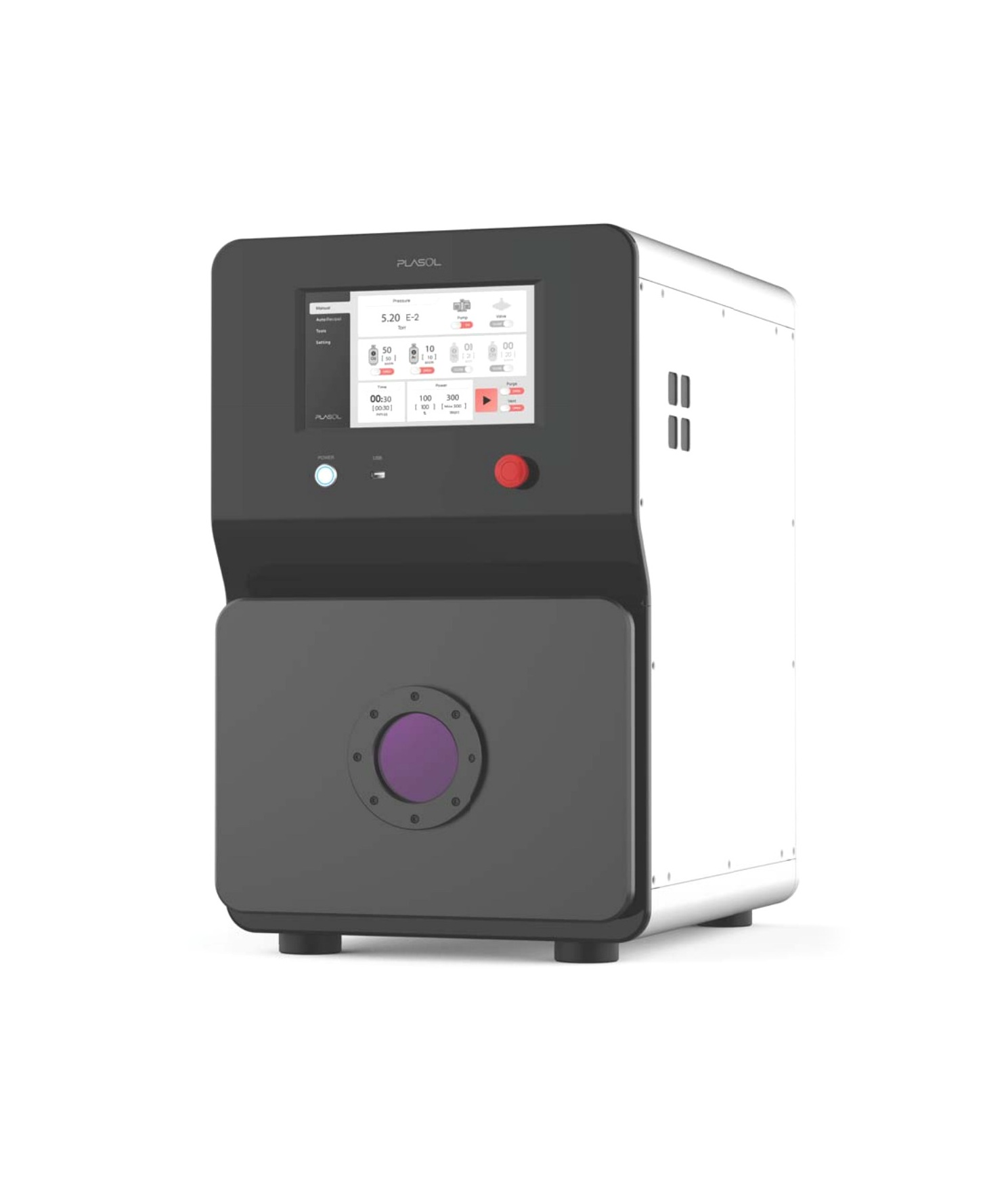
Key Features
- Low-pressure plasma treatment: a dry-etching process that modifies the near-surface layer without damaging the bulk material properties
- Low frequency generator: up to 500 W (level control 0–100%) at 10–50 kHz, with active fan cooling
- CCP discharge with dual electrodes for high plasma uniformity and conformal treatment of intricate contours and various sample sizes
- Supports ashing, etching and descum, plus hydrophilic / hydrophobic treatment, cleaning and activation
- Rectangular chamber of 200 × 230 × 100 mm (W × D × H) in anodized aluminum (6061)
- Up to 4 mass flow controllers (0–100 sccm) for O2 or air, N2, Ar, CF4 and other gases; designed for fluorine-based gases
- Fully automatic mode (10 recipes) and manual mode, set from a 10.1-inch touchscreen PC
- Adjustable power (W), gas flow (sccm) and duration (mm:ss), with a Pirani gauge (0.5 mTorr to atmosphere) for pressure measurement
About the Plasol PES-200 Low Frequency Plasma Asher
The PES-200 from Plasol Inc., South Korea, is a plasma surface treatment system that the manufacturer calls a low pressure plasma cleaner. Its low frequency generator (10–50 kHz, up to 500 W) works in a rectangular chamber that accommodates samples of various sizes and shapes, and the system supports plasma ashing, etching and descum.
It is designed to use fluorine-based gases, and up to four mass flow controllers (0–100 sccm) feed process gases such as O2 or air, N2, Ar and CF4. Besides ashing, etching and descum it performs surface modification treatments, including hydrophilic and hydrophobic treatment, cleaning and activation.
Plasma is generated by capacitively coupled plasma (CCP) discharge between dual electrodes, which gives high plasma uniformity and conformal treatment of intricate contours. An embedded system with a 10.1-inch touchscreen runs recipe-driven automatic operation (10 recipes) or manual mode, and a Pirani gauge, mass flow controllers and a finely adjustable generator provide accurate process control.
PES-200 specifications
| Model | PES-200 |
|---|---|
| Manufacturer | Plasol Inc., South Korea |
| Type | Low pressure plasma cleaner (low frequency plasma asher) |
| Plasma discharge | CCP (capacitively coupled plasma) with dual electrodes |
| Generator | Max. 500 W, level control 0–100% |
| Frequency | 10–50 kHz, active fan cooling |
| Process gases | O2 or air, N2, Ar, CF4 and others (1/4" Lok fittings); designed for fluorine-based gases |
| Mass flow controllers | Max. 4 (0–100 sccm) |
| Reactor chamber | W 200 × D 230 × H 100 mm, rectangular; anodized aluminum (6061) |
| Pressure gauge | Pirani, 0.5 mTorr to atmosphere |
| Vent and N2 purge inlet | 1 channel each |
| Operation | Fully automatic mode (10 recipes in total) and manual mode |
| Control | 10.1" touchscreen PC (Linux embedded system) |
| Adjustable parameters | Power (W), gas flow (sccm) and duration (mm:ss) |
| Configurable options | Vent and purge time (s), working pressure (Torr), chamber and gas valve open/close, vacuum pump on/off |
| Vacuum pump | 2-stage oil rotary pump (RV12, Edwards); peak pumping speed 8.4 cfm (238 L/min); KF25 connection; W 430 × D 158 × H 261 mm; 220 V AC supplied by the plasma cleaner |
| Ultimate pressure | 1.5 × 10⁻³ Torr (1.5 × 10⁻² Torr with Fomblin®) |
| System dimensions | W 410 × D 575 × H 660 mm |
| Electrical supply | 110–250 V AC |
| Compliance | CE |
Specifications are as published by the manufacturer, Plasol. Download the product brochure or contact us to confirm the configuration for your laboratory.
Low frequency plasma asher: frequently asked questions
Is the Plasol PES-200 a plasma cleaner or a plasma asher?
Both names describe the same system. Plasol calls the PES-200 a low pressure plasma cleaner. It operates at a low frequency (10–50 kHz) and supports plasma ashing, etching and descum processes as well as surface modification, so it is also known as a low frequency plasma asher.
What is the PES-200 used for?
Typical applications listed by the manufacturer are PDMS microfluidic chip bonding and activation, hydrophilic or hydrophobic treatment of plastics, electrode cleaning and wire bonding, graphene and 2D TMD transfer and activation, photoresist removal, plasma ashing and descum, photocatalyst activation and OLED fabrication.
What generator and discharge does the PES-200 use?
A generator of up to 500 W with level control from 0 to 100%, operating at 10–50 kHz with active fan cooling. Plasma is formed by capacitively coupled plasma (CCP) discharge between dual electrodes, which gives high plasma uniformity.
Which process gases can the PES-200 use?
O2 or air, N2, Ar, CF4 and others, through 1/4 inch Lok fittings. The system is designed to use fluorine-based gases and can be fitted with up to four mass flow controllers (0–100 sccm).
How large is the chamber and how is the PES-200 controlled?
The rectangular reactor chamber is 200 × 230 × 100 mm (W × D × H) in anodized aluminum (6061). A 10.1-inch touchscreen PC with a Linux embedded system sets power, gas flow and duration, with a fully automatic mode (10 recipes) and a manual mode. A brochure is available from the button at the top of this page.
Where can I buy the Plasol PES-200 in India?
Multiflo Instruments, based in Navi Mumbai, supplies Plasol plasma systems in India. Our team can advise on the PES-200, send a quotation, and arrange installation, training, calibration and after-sales service. Use the Contact Us button or call +91-22-44516175.
Related plasma, decapsulation and sample preparation equipment
Plasma Cleaners
Digit Concept iSP 3, 300 W RF generator at 13.56 MHz
Plasma Decapsulator
Digit Concept iMIP-Dcap II microwave induced plasma decapsulation
Laser Decapsulator
Digit Concept SLP 500 and SLP 1000 laser IC decapsulation
Acid Decapsulator
Digit Concept iSA-777 acid decapsulation system
Furnaces & Ovens
Nabertherm furnaces up to 3000 °C and ovens up to 1400 °C
Ball Mills
Across International PQ-N4 planetary ball mills, down to 0.1 micron
Get A Free Instrument Consultation!
We can suggest products to our customers to make them the leaders in their respective industries.